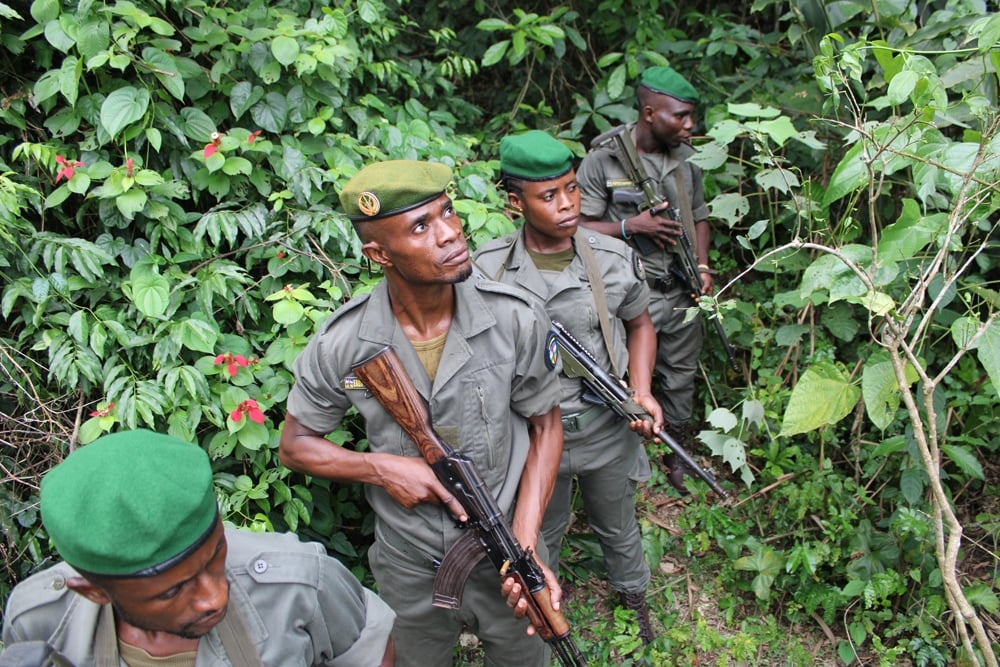
“You’re in the forest for a minimum of seven days at a time,” says Yoann Galeran. “Sleeping out there. Moving constantly.”
Galeran has been working deep in the Congo Basin, in Dzanga-Sangha Special Reserve, since 2018. He started as a ranger trainer, supporting law enforcement operations through a specialist conservation organisation. Today, he serves as park director on their behalf, working within a co-management structure alongside the Ministry of Water and Forests and the World Wide Fund for Nature (WWF).
Roughly 340 staff (including 140 rangers) operate within the park, the majority dedicated to law enforcement, but the work here extends far beyond patrols. Dzanga-Sangha sits within a larger transboundary landscape that connects the Central African Republic, Cameroon, and the Republic of Congo. Wildlife moves freely across these borders, and so do threats.
“There are regular patrols between countries,” Galeran explains. “But our main mandate is within the Central African Republic.”
That landscape comes with its own pressures. Illegal logging operations move through remote forest corridors. Artisanal mining for gold and diamonds brings an influx of people, often followed by organised poaching networks. “It’s not just one issue,” he says. “There’s a convergence of different types of criminal activity.”
Law enforcement is a constant presence, but it cannot operate in isolation. Around 50,000 people live in and around the reserve, many of whom depend directly on the forest for survival. The challenge is not to remove that dependence, but to manage it.
Dzanga-Sangha’s approach is built on the reality that communities are not excluded from the forest. Instead, the focus is on sustainable use, ensuring that resources can support both people and wildlife over the long term. “It’s about good management of the resources,” Galeran says. “And making sure benefits are coming from conservation.”
Those benefits take different forms. Agroforestry projects provide alternative income streams. Ecotourism brings employment. Community programmes support education, health, and local governance. At the centre of this approach are the Ba’aka people.
“They are essential to conservation,” he says.
Ba’aka communities have lived in these forests for generations, with deep knowledge of animal behaviour, plant use, and movement through dense terrain. That knowledge is respected and actively integrated into conservation work.
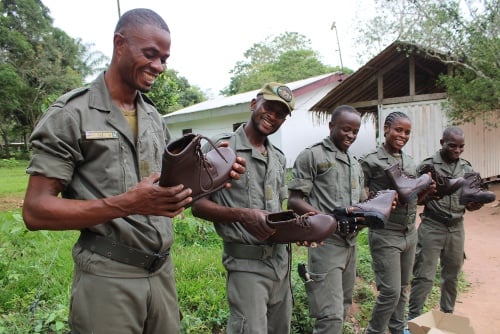
Today, Ba’aka men and women work across the park as rangers, trackers, researchers, and community liaison officers. They are also central to ecotourism programmes, including gorilla tracking initiatives that rely on their expertise. “They are the best trackers,” Galeran adds. “They have the skills of the forest.”
Dzanga-Sangha is also one of the last strongholds of the African forest elephant, a species that has declined dramatically across Central Africa. The park has not been immune to that pressure. In 2013, during a period of political instability, armed groups entered the reserve and killed dozens of elephants. Across the country, numbers dropped sharply during years of conflict. However, within Dzanga-Sangha itself, the population has held. “Today, the number is close to 2,500,” Galeran says. “It has remained stable.”
Part of that stability comes down to consistent monitoring. At Dzanga Bai, a mineral-rich forest clearing, teams track individual elephants as they gather, often in large groups of 50 to 200. It is one of the few places in the world where forest elephants can be observed so closely, offering a rare window into a species that is otherwise largely hidden.
The forest is also home to the western lowland gorilla, another key focus of conservation and tourism in the reserve. Gorilla tracking programmes have been running here since the late 1990s, employing local Ba’aka trackers and drawing visitors into the forest.
The work, however, is fragile. “When a dominant male dies, the group structure can collapse,” Galeran explains. In recent years, that is exactly what happened. One by one, the habituated groups used for tourism lost their silverbacks. By 2023, there were no groups left open to visitors.
Rebuilding has taken time. New groups have since been identified and are undergoing habituation, a slow process that allows gorillas to become accustomed to human presence without stress or disruption. One group reopened to tourism in 2025, with two more currently in progress. “It took about a year to habituate the group and open it to tourism, a process that usually takes more than three years,” he says. “But it’s important for research, for monitoring, and for managing disease risks between humans and wildlife.”
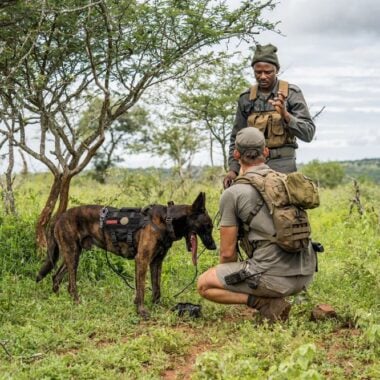
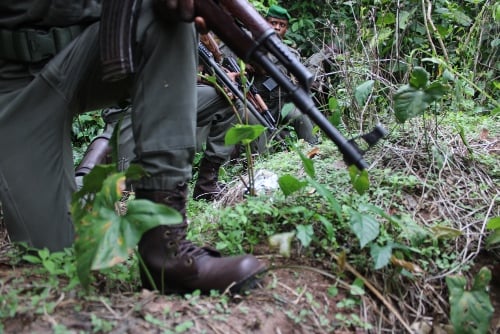
For rangers, this is one of the most physically demanding environments in conservation. Patrols can last more than a week, moving through dense vegetation where visibility drops to a few metres. The ground is uneven, often wet, and constantly shifting underfoot. Everything, from equipment to food to shelter, has to be carried in. Encounters with wildlife are close and unpredictable, and navigation depends as much on experience as it does on maps.
What emerges in Dzanga-Sangha is a model that looks very different from more familiar conservation narratives. It isn’t built around separation, but rather integration. It’s also not about removing people from landscapes, but working with them. It is a system of overlapping efforts, law enforcement, community development, research, and tourism, all held in balance. Looking ahead, that balance is becoming even more central.
“We are working on a larger landscape approach,” Galeran says. “Putting communities at the centre.” The idea is to expand beyond the park itself, linking conservation with agriculture, energy, and local economies. Solar projects, sustainable farming, and forest-based enterprises all form part of that vision.
It is a long-term change, one that recognises that conservation here will only succeed if it works for the people who live in the forest as much as it does for the wildlife. In a place where everything is connected, there is no other way.
Cheers,
The Jim Green Team
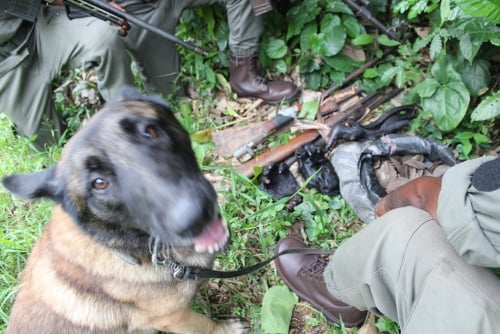
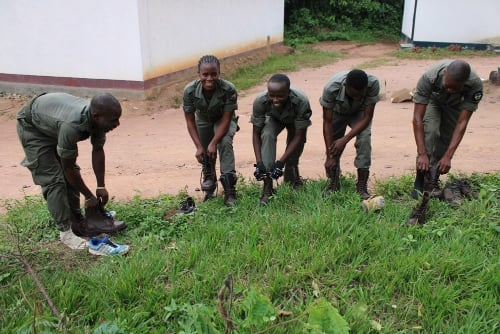
Through our Boots for Rangers initiative, run in partnership with the Game Rangers Association of Africa, we donate one pair of boots to a ranger for every ten pairs sold from our Ranger range. These boots are now supporting conservation teams at sites across Africa, with over 6,000 pairs already on the ground.